How a dog jumps
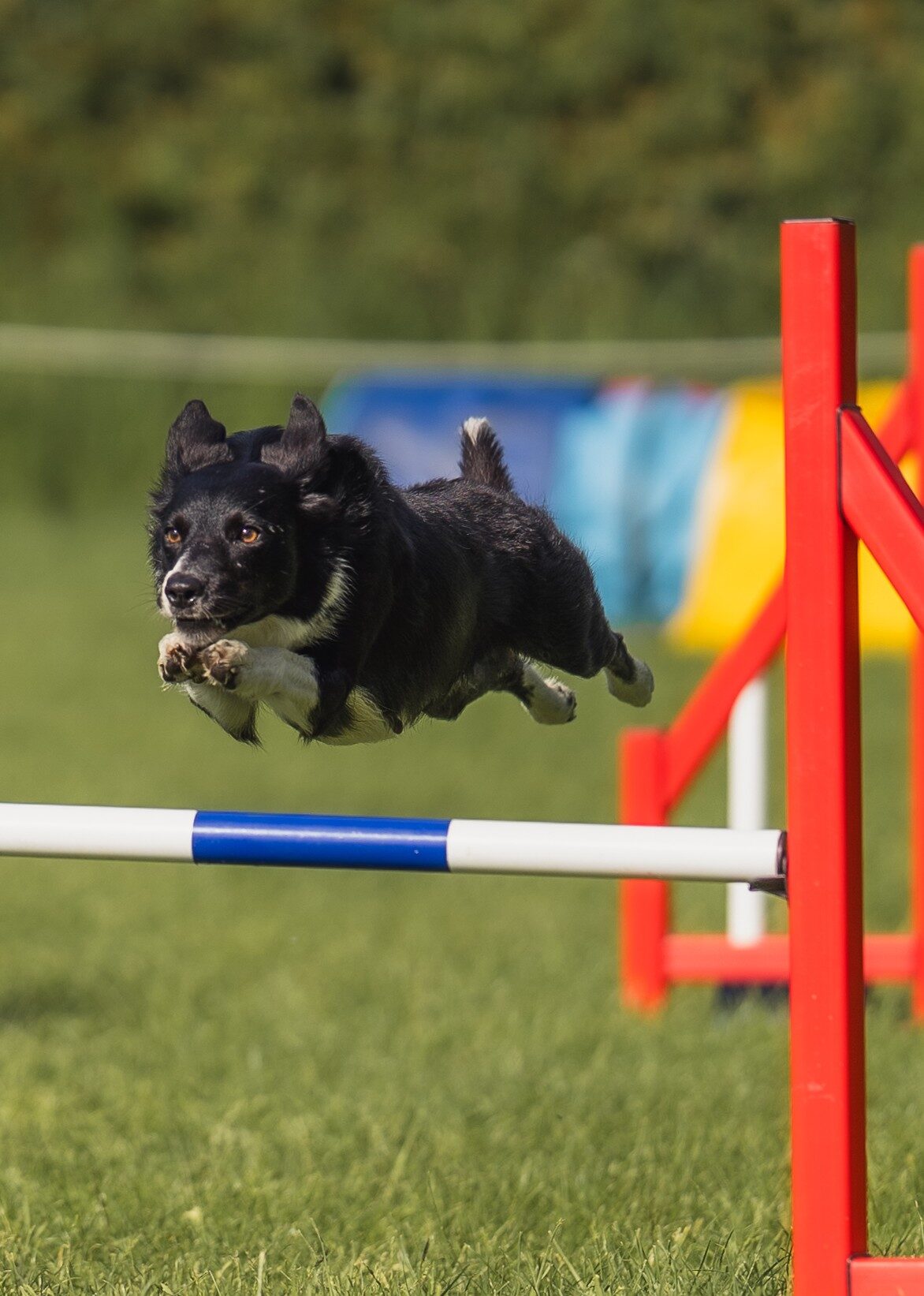
Every dog uses the same sequence of movements to clear a jump — regardless of breed or size.
Comparison between horses and dogs
Dogs have greater limb angulation, which allows a greater stride length relative to body size, giving them a greater running speed for their size. Typically a dog moves at 0.62mph/lb, whereas a horse moves at 0.04mph/lb. In addition the canine spine is much more flexible than a horse, and the front leg has a separate radius and ulna, allowing the leg to rotate along its axis and therefore help the dog make fast turns. In contrast, a horse cannot arch its spine to help propulsion and the fusion of the radius and ulna in the foreleg impedes the horse's ability to make sharp turns.
Trajectory is the term for the path through the air that an animal takes while jumping. In horse jumping, it is desirable for the trajectory to be that of a bascule (an arc shaped like a semi circle). To achieve this, a horse should leave the ground as far away from the jump as it is high. Horses tend to rely on the rider's input for guidance on take-off points.
In agility, the space between each take-off and landing point alters for the whole course, and the jumps may be taken straight, on angle or on a turn — so dogs have to decide on the best technique to negotiate the jump. As handlers, we tend to give direction and cues, but the actual jumping technique is left to the dog. Training is important here as the dog must make a decision on speed, height, take-off, landing direction and trajectory.
The mechanics of the jump
When a dog jumps, the hindquarters provide the propulsion whilst the shoulder, elbow and wrist provide the degree of lift and absorb much of the impact on landing. Regardless of breed or size, all dogs jump using the same sequence of movements.
As a dog approaches a jump, the front feet are placed, one slightly ahead of the other, at a take-off spot. This point is determined by a number of factors — speed, height of jump, weight-to-height ratio of dog, ground conditions, experience and confidence of the dog, and dog's general strength and well-being.
As the front feet are planted, the head is lowered and the front legs are slightly flexed. Then the spine is flexed as the rear legs are brought forward and planted slightly ahead of the front feet.
The front legs are extended, pushing the front body upwards and raising the head to help with upward thrust. The rear legs are then extended to propel the dog upward and forward. Once the dog is in the air, the head is lowered closer to the outstretched front legs to help with forward thrust and to reduce drag.
At the apex of the arc, the dog should lower his head and lift his tail to help rotate the body forward and downward.
After the outstretched front legs have hit the ground — one leg slightly ahead of the other — the rear legs are drawn forward under the body to absorb some of the impact of landing and to continue with the forward running gait on landing.
The front end as shock absorber
The front end is the dog's main shock absorber. When a dog jumps, the front paws are the first to hit the ground. The upper arm absorbs the main jolt of this impact as the elbow travels backwards. An analogy to this would be a shock absorber on a car. An important aspect to some shock absorbers is their stroke length. In other words, what is the distance it can be compressed before it bottoms out? The same thing holds true for the upper arm. The longer the path is that the elbow travels, the greater its length to be compressed — therefore a dog with greater angulation can also absorb the impact of landing better than a dog with straighter front legs. This is because the greater angulation allows the dog an imperceptibly longer period of time for the muscles to slow the impact, whilst the bones and tendons behave like springs, folding up then straightening out again.
Centre of gravity
In the majority of dogs, the centre of gravity is just behind the shoulders, about one third of the way up the body. This varies slightly with the length and weight of head and neck, length of legs, and weight and structure of torso.
When the centre of gravity is moved out of position without changing the base beneath it, movement results.
In all movement, the centre of gravity transcribes an arc with the low point at the starting position, moving upward and downward with each cycle of activity. Upward movement requires muscular effort but does not contribute to forward movement. Therefore, the flatter the arc is, the less energy is wasted in upward movement.
In order to jump successfully, a dog needs to raise its centre of gravity high enough for all of its body to clear the height and width of the jump. The ability to raise the centre of gravity is determined by conformation, confidence and experience. The hardest working part of the dog is the front end, as it is responsible for supporting more than half of the dog's weight. It is also mostly responsible for shifting the centre of gravity, and therefore providing lift.
About the author
Kate Clapperton is the founder of Rippletrix Border Collies in Sheffield. Kate is a Kennel Club Assured Breeder and Veterinary Physiotherapist producing dual KC and ISDS-registered working Border Collies alongside show-line KC-registered Border Collies. Kate teaches canine conditioning, agility, and orthopaedic recovery at her Sheffield yard.
Pieces along the same line
Want more like this in your inbox?
The GenoVaq journal publishes long-form pieces for breeders and buyers — welfare, health-testing, breeding decisions, marketplace mechanics. New writing every week or two.