The puppy pack I still send with every litter
When Kate Clapperton qualified as a Kennel Club Assured Breeder, every puppy she bred left home with a proper information pack — socialisation chart, exercise-by-age table, feeding schedule, worming record, vaccination record, poisons list, and breed-specific advice.
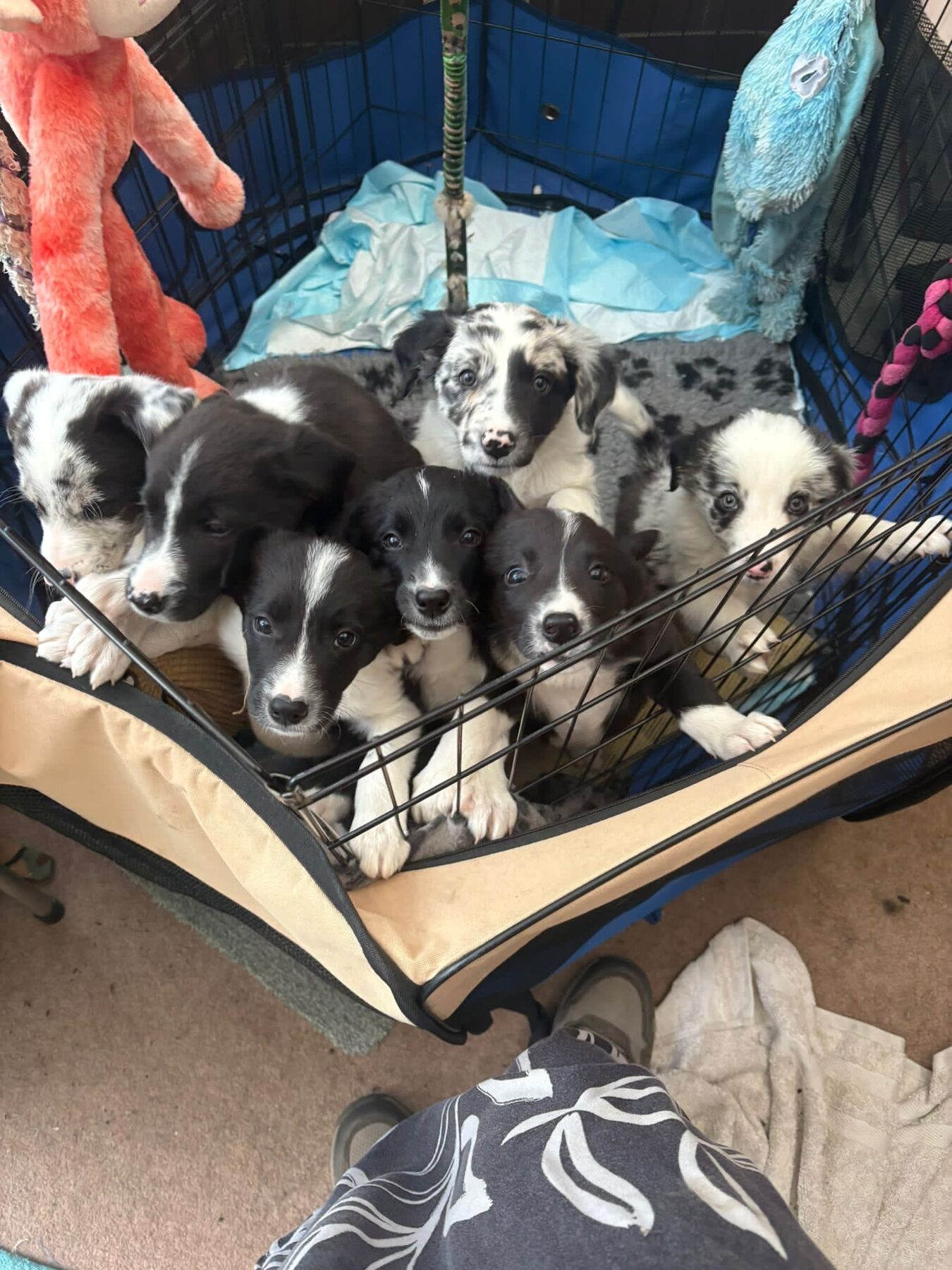
Years ago, when I qualified as a Kennel Club Assured Breeder, the scheme came with a very clear expectation. Every puppy I bred left home with a proper information pack. Not a slip of paper. A proper document — socialisation chart, an exercise-by-age table, a feeding schedule, a worming record, a vaccination record, the poisons list, and a page on breed-specific advice.
It was a lot to put together. It was also, in my view, exactly the right amount.
The scheme itself — as far as I understand it — doesn't run in quite the same form any more. But I never stopped sending the pack. The puppies didn't stop needing the information just because the scheme stopped requiring it. That's my honest answer.
Here's what's in it, and why I still think every puppy should leave the yard with one.
What's in the pack
Socialisation advice, with a printable chart. Sixteen weeks. That's the window. After that, the door on socialisation closes and you're rebuilding rather than building. The chart is one page: people, animals, environments, situations, gentle handling. Four boxes per item. You tick a box for every positive encounter your puppy has. Aim for four before your puppy is sixteen weeks old and you've done more than most owners manage in the whole of the dog's life.
An exercise-by-age table. Five minutes of exercise per month of age, up to twice a day, until the puppy is fully grown. That's the rule. Under-exercise a puppy and you can't shift them off the sofa. Over-exercise a puppy and you damage the growing joints. Both ways lead to a lifetime of problems. The table gives you the numbers for every month up to a year.
Feeding advice, and the poisons list. What to feed. What to never feed. Why complete food is different from complementary food. What to do if your puppy doesn't eat. What growth curve to expect. And — because it saves lives — an unambiguous list of the household things that can kill a dog: chocolate, grapes, xylitol, onions, and so on. I've had owners phone me weeks after collection because the puppy grabbed something off the floor. That page is the reason they knew to phone the vet immediately.
Grooming, with the CHAIR rule. Cleanliness, Health, Appearance, Inspection, Relationship. Grooming isn't cosmetic. It's the daily contact you use to spot lumps, check ears, keep the nails right, and reinforce that the dog can be handled. Every Rippletrix pup has been groomed and had their nails clipped from two weeks of age — the anxiety around it is removed before the pup meets a new owner. That's easier for the pup, easier for the owner, and much easier for the vet.
A worming record, a vaccination record. With the products used, the dates, and the doses. So the new owner and their vet start on the same page. Not a photocopy of a photocopy — a specific record for the specific puppy.
Breed-specific advice. For me, that's the Border Collie chapter. If you take one thing away from that page: five to ten minutes of mental exercise a day tires them out. Excessive physical exercise doesn't. Run a Border Collie for two hours on the moor and they come home ready to reorganise your living room. Give them ten minutes of trick training and they'll sleep the afternoon. That's the whole game.
Why I kept sending it
Three reasons.
First, because the information doesn't go out of date. The fourteen-week socialisation window hasn't moved. The poisons list hasn't shortened. The five-minutes-per-month exercise rule still holds. If I stopped sending the pack the day a scheme changed, the puppies would be the ones who lost out. Not the scheme.
Second, because a puppy owner's first three months are the ones that shape the next fifteen years. If I can compress everything I know into one document that lives in a kitchen drawer next to the lead, and it saves one vet visit or one behavioural referral or one dog ending up in rescue, that's worth the printer ink.
Third, because it's part of what "assured" is supposed to mean. Assured that the pup came from a health-tested line. Assured that the pup came from a home, not a shed. Assured that the paperwork was done. And assured that when the pup left, they left with everything the new owner needed to keep them well. If a scheme stops requiring one of those things, that's the scheme's call. It doesn't change what I think a breeder should still do.
Where to find it
The GenoVaq Welfare Hub has published my pack in two volumes. Both are free. Both come home with every Rippletrix puppy in print. Both are available to any owner who didn't come to me, because the puppies who came from somewhere else deserve the same information.
That's the honest reason I still send it.
— Kate
About the author
Kate Clapperton is the founder of Rippletrix Border Collies in Sheffield. Kate is a Kennel Club Assured Breeder and Veterinary Physiotherapist producing dual KC and ISDS-registered working Border Collies alongside show-line KC-registered Border Collies. Rippletrix is built on three foundation lines Kate spent years researching and combining. Every pup is fully health tested to the recognised breed panel, BVA eye tested and BAER tested before leaving the yard. Every bitch is spayed after a single litter as breeder policy. Rippletrix's four proven stud dogs — Switch, Rewind, Dallas and Ghost — are listed on GenoVaq, with Rippletrix Hell Raiser joining the roster when he matures.
Pieces along the same line
Top Tips for a Perfect Border Collie
Nearly forty years of Border Collies, condensed into the recall, off-switch, toilet-training and hard-wired-behaviour advice Kate Clapperton — Rippletrix Border Collies, Kennel Club Assured Breeder and Veterinary Physiotherapist — gives to every new puppy owner.
Read the piece →Installing confidence in your puppy, from birth onwards
Every puppy will one day meet something that frightens them — a vet's table, a muzzle, a cone, a night in a kennel away from their owner.
Read the piece →Want more like this in your inbox?
The GenoVaq journal publishes long-form pieces for breeders and buyers — welfare, health-testing, breeding decisions, marketplace mechanics. New writing every week or two.