Using ultrasound in a canine pregnancy
Why every breeding bitch benefits from an ultrasound scan — for early diagnosis, viability, gestational dating, monitoring foetal development, and (critically) after the whelping to be sure nothing has been retained.
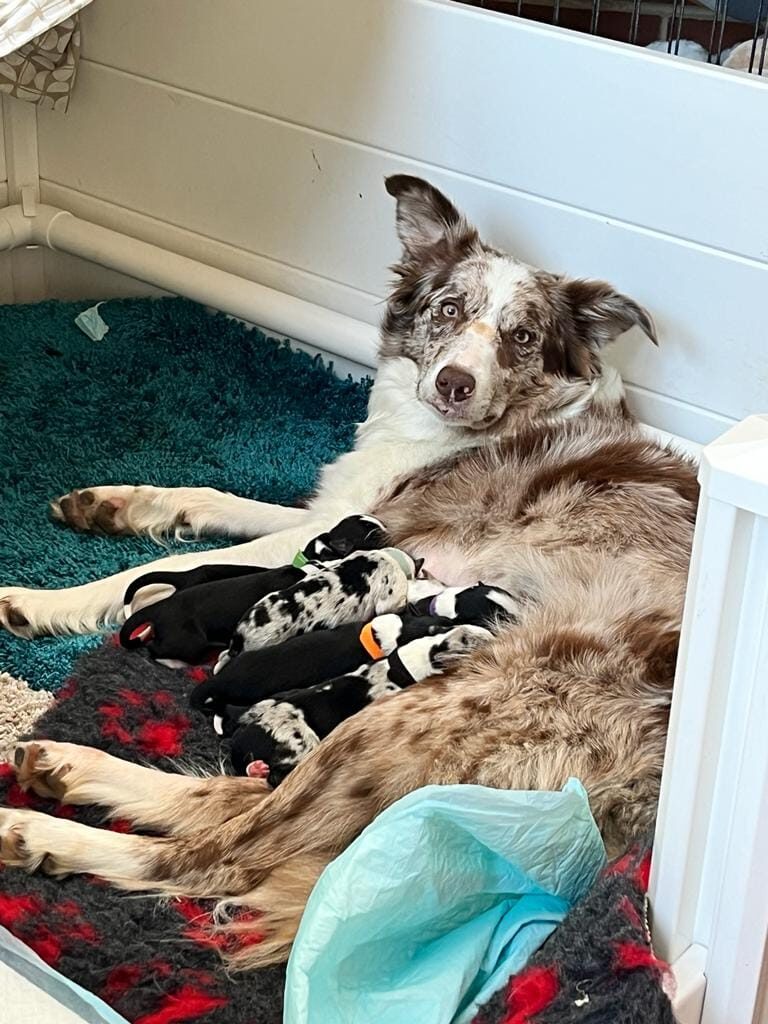
The ultrasound scanner projects high-frequency waves through the tissues to create a live image of the structures beneath the skin. It is a harmless and pain-free process, and it can be used in several different ways throughout your dog's pregnancy.
Usually, it is used to determine whether your dog is pregnant or not. An ultrasound can also show whether there are puppies present, their heartbeats, and — in some cases — a rough indication of numbers.
Post-whelping, the ultrasound can be used to ensure there are no puppies left inside and that the afterbirth has been passed following each puppy.
How the scan works
Your dog will be allowed to relax before the scan and usually doesn't need shaving in order to carry out the ultrasound.
Water-based gel is applied to create a good signal. The probe is gently pressed on your dog's lower belly and slowly moved around to show images and videos on the screen. The probe emits sound waves which bounce off the developing puppies to show real-time images.
Six reasons to scan your breeding bitch
Early diagnosis
A dog pregnancy scan is a good tool for confirming whether your dog is pregnant or not. This confirmation enables you to prepare adequately for the arrival of puppies and ensures your dog receives the appropriate care and nutrition.
Viability of the foetuses
Determining the viability of the foetuses is essential for both the bitch's and puppies' wellbeing. Abnormalities and complications can be identified so intervention is possible. This ensures a healthy pregnancy with limited complications during whelping, and that the bitch can be fed and exercised accurately.
Approximate number of puppies
Knowing roughly how many puppies are growing inside the bitch will help her wellbeing. It also helps in the future puppies' care and development, and in finding new owners.
Monitoring foetal development
The ultrasound scanner is safe to use, so ongoing checks can be made on the growing puppies and to identify any complications.
Determining the gestational age of the puppies
By knowing the exact date the puppies should be born, we can plan for whelping and structure the bitch's care throughout.
Post-whelping check
An ultrasound scan can be used post-whelping to be sure that the bitch has passed all puppies and all afterbirth. If she has retained anything after the whelping, this can prove fatal to her and to any nursing puppies. Every breeder should do this scan. Not enough do.
The parts a fertility clinic can help with
At my clinic I also assist in some whelpings, give advice on fertility and pregnancy supplements, and advise on litter growth and development. I provide and suggest post-whelping exercise programmes for the bitch to help tone her up so she can return to work or sport sooner.
Home visits for ultrasound and fertility testing are available on request.
And the microchipping side, briefly
The law states that all dogs must be microchipped and registered with an approved database by the age of 8 weeks. Cats should be microchipped and registered by the age of 20 weeks. As an owner you could be fined £500 for having a dog that is not chipped.
Dog breeders must microchip all of their puppies — including the ones they keep — before sale and before eight weeks. At Rippletrix and at the clinic, chipping is done in the litter's own environment where possible, so the litter doesn't have to be transported and stressed.
About the author
Kate Clapperton is the founder of Rippletrix Border Collies in Sheffield. Kate is a Kennel Club Assured Breeder, Veterinary Physiotherapist and canine behaviourist. She runs a canine fertility clinic under Muppets Canine Therapy in Sheffield, offering cytology testing, male dog fertility analysis, ultrasound scanning, whelping assistance and microchipping. This piece is adapted from her clinic pages with her permission.
Pieces along the same line
How to read a canine semen sample
Motility, morphology, concentration, colour — the four things a fertility analyser reports back on every ejaculate, and what each one tells you about your stud dog.
Read the piece →When to mate: the four stages of a bitch's season
Proestrus, estrus, diestrus, anestrus — and the split season that misleads a lot of breeders.
Read the piece →Want more like this in your inbox?
The GenoVaq journal publishes long-form pieces for breeders and buyers — welfare, health-testing, breeding decisions, marketplace mechanics. New writing every week or two.